

Close Readings in the Holdings of saai
This project views archives as the foundations of social processes, and thus as an ideal field of research and experimentation for investigating sustainable knowledge creation and data practices for the future. The aim is to use selected objects from the archive to make the saai | Archive for Architecture and Engineering transparently visible, within an architecture-specific context, as a place where knowledge is not only preserved but also generated, transformed, obscured or destroyed, and to critically reflect on the significance of these processes in the emergence and consolidation of architecture-related narratives.

Photographic print of a school building in Berghausen by Alfred Fischer and Maria-Verena Gieselmann (from the 1950s), Estate Alfred Fischer, KIT. ©saai
Facts
| Project duration: | 2026–ongoing |
| KIT researchers: | Prof. Dr. Anna-Maria Meister, Mechthild Ebert – saai | Archive for Architecture and Civil Engineering |
Text (Short description not more than 700 signs) “Frauen Bauen Baden-Württemberg at the saai” involves: a) researching and studying female architects of the 20th century and their completed projects in Baden-Württemberg—based on the saai’s collections; b) searching for any remaining materials from these architects for the archive; and c) integrating the results into the Frauen Bauen-website. The project is carried out as part of architecture education and aims, in collaboration with students, to fill the gaps regarding female architects in the archive and in architectural knowledge in Baden-Württemberg, as well as to make the results visible and searchable via the existing website www.FrauenBauen.com.

Modell House Axster, Hilde Axster-Trappmann, Foto: Doris Hallama.
Facts
| Funder: | Wüstenrot Stiftung |
| Overall budget: | €31.612 |
| Grant amount: | €16.000 |
| Role KIT: | Project manager |
| Project duration: | 2026–2027 |
| KIT researchers: | Doris Hallama, Simon Rötsch – saai | Archive for Architecture and Structural Engineering |
Project partners
Team Frauen Bauen München (Doris Hallama, Jana Hartmann, Anna Jacob, Zora Syren).
A Socioecocritical Inquiry
This project investigates over three decades of global artistic responses to the ecological disaster caused by the 1986 explosion at the Chornobyl nuclear power plant in northern Ukraine. By examining how artists from Europe, Asia, the Americas, and other regions have engaged with this catastrophe, it deepens the readers understanding of art’s role in addressing ecological emergencies. While art historical research may not bring about immediate material change, this work aspires to shift academic discourse in the humanities towards environmental concerns, ultimately encouraging public support for mitigating the devastating consequences of the Anthropocene.

Facts
| Funder: | Alexander von Humboldt-Stiftung |
| Programme: | Philipp Schwartz-Initiative incl. Bridge-Funding |
| Grant amount: | Approx. €74.620 | €20.000 (flat-rate subsidy) |
| Role KIT: | Project manager |
| Project duration: | 2025–2027 |
| KIT researchers: | Prof. Dr. Oliver Jehle, Dr. Nazar Kozak, PD Dr. Dr. Jesús Muñoz Morcillo – Professorship of History of Art |
Project partners
KIT International Affairs Business Unit.
Contact
Prof. Dr. Oliver Jehle
Phone: +49 721 608 42190
oliver.jehle∂kit.edu
PD Dr. Dr. Jesús Muñoz Morcillo
Phone: +49 721 608 42174
jesus.morcillo∂kit.edu
The Department of Homeland Security’s Social Media Visual Strategy
This research focus examines the strategic use of works of art from the canon of art history by the U.S. Department of Homeland Security (DHS) on social media. Based on the DHS’s self-portrayal as the guarantor of a secure and future-oriented nation, the study aims to analyze how this vision is built upon an aggressive visual strategy. By examining and interrogating historical continuities, the research investigates the extent to which this form of digital image dissemination functions as a political instrument of propaganda, and why this mode of visual politics does not contribute to a ‘better’, utopian America—but instead advances authoritarian and inhumane models of society.

A Heritage to be proud of, a Homeland worth Defending. Screenshot from the official DHS Facebook account. ©DHS/Facebook
Facts
| Project duration: | 2025–2026 |
| KIT researchers: | Dr. Ines Kelly – Professorship of Theory of Architecture |
The Art Collection of the Karlsruhe Institute of Technology
This project reframes ‘access-making’ as a critical and relational practice to explore how disability and race are configured in Donald Rodney’s Autoicon (1997–2000). More than a digital memorial, Autoicon is approached as a speculative interface that reimagines authorship, posthumous presence, and the ways in which access is shaped by both aesthetics and politics. Constructed from Rodney’s medical records, writings, and images, Autoicon offers a dispersed digital portrait that resists coherent identity. The project positions it as an early prototype of AI subjectivity, anticipating current debates on algorithmic representation and the ethics of digital memory. By examining the intersections of art, disability, and technology, this project rethinks code not as control but as a catalyst for access and aesthetic possibility. Referencing Jeremy Bentham’s Auto-Icon, Donald Rodney replaces the body with a dynamic archive, revealing how disabled artists have long anticipated and reshaped emerging technologies.

Facts
| Funder: | KIT Freundeskreis und Fördergesellschaft e. V., Sparkasse Karlsruhe, dm-drogerie markt |
| Programme: | Research grant for non-personnel costs |
| Project duration: | 2025–2026 |
| KIT researchers: | Prof. Dr. Oliver Jehle – Professorship of History of Art |
Project partners
Andrea Stengel and Jonas Zilius, KIT Communication and Marketing (KM) and Media Production (MEP) departments.
Practical Laboratory – Lime/Hemp Plaster and Natural Stone Masonry
In a village composed of abandoned and partially dilapidated stone houses situated in the forests of Piemont in northern Italy, student workshops are held to contribute to their reconstruction. Within these hands-on workshops, participants engage with locally sourced materials and employ historical construction techniques, including traditional stone masonry and the application of thermally efficient plasters based on lime and hemp. In addition, experimental investigations into historical lime plaster techniques are conducted. The resulting material samples are curated and exhibited in the KIT materials library.

Facts
| Project duration: | 2025–2026 |
| KIT researchers: | Hon. Prof. Kerstin Müller – Professorship of Circular Construction Annette Gerteiser |
Project partners
Canova Fondazione (Italy).
A Rammed Earth Project in Addis Ababa, Ethiopia
The DesignBuildProject combines traditional Ethiopian building culture with modern rammed earth technology, making a significant contribution to the preservation of valuable cultural heritage. At its core is the further developed “Tukul 2.0,” which maintains the characteristic circular form, materiality, and social function of the East African one-room house. At the same time, structural weaknesses such as moisture damage and limited durability are addressed. Through the collaboration of KIT, AAU, and local craftsmen, a sustainable architectural approach emerges that strengthens cultural identity while promoting resilient and forward-looking construction methods.

The rammed walls made of two different types of earth. ©NB
Facts
| Funder: | Sto-Stiftung |
| Overall budget: | €30.000 |
| Grant amount: | €25.000 |
| Role KIT: | Project manager |
| Project duration: | 2025–2026 |
| KIT researchers: | Lisa Behringer, Zegeye Cherenet Mamo, Prof. Dirk Hebel, Hanna Hoss – Professorship of Sustainable Construction |
Project partners
Addis Ababa University, Ethiopia.
The Residential Heritage in Times of Multiple Crises
The research project aims to integrate approaches to sustainability and resilience in addressing the residential architectural heritage from the Soviet era, aiming to generate foundational knowledge and develop specific recommendations for resilient and sustainable urban development in cities across Ukraine, the Caucasus, and the Baltic region. The KIT subproject is focusing on aspects of migration and the need for housing provision, as well as climate adaptation and climate protection. The work builds on the results of the first phase of research, in which the sub-project analysed morphological and typological transformation processes of the residential heritage from the 19th and 20th centuries, identifying significant risks as well as potentials.

Isonometrie, Tramway Workers` Housing Complex in Tbilisi. ©Ksenia Gulyaeva
Facts
| Funder: | Federal Ministry of Education and Research (BMBF, Germany) |
| Programme: | Area Studies |
| Overall budget: | €381.000 |
| Grant amount: | €381.000 |
| Role KIT: | Project manager |
| Project duration: | 2024–2027 |
| KIT researchers: | Prof. Dr. Barbara Engel, Dr. Anastasia Malko, Ekaterina Gladkova, Marina Sapunova – Professorship of International Urban Planning and Design |
Project partners
RWTH Aachen, GWZO Leipzig.
A Global Superstar in Dresden
The year 2027 sees the 450th anniversary of the birth of Peter Paul Rubens (1577–1640). The Gemäldegalerie Alte Meister of the Staatliche Kunstsammlungen Dresden is collaborating with German and international partners in planning a major exhibition featuring around 100 works. Technological research conducted over a three-year period has provided new insights into Rubens’ painting techniques and the division of labour within his workshop. The exhibition focuses on key works from the collection and significant international loans. Following several spectacular restorations, viewers will be treated to a new perspective on Dresden’s important Rubens collection and a comprehensive insight into Rubens‘ multifaceted career as an artist, diplomat, and cosmopolitan.

Facts
| Project duration: | 2024–2027 |
| KIT researchers: | Prof. Dr. Holger Jacob-Friesen – Professorship of History of Art |
Early Modern Discourse on Nature and Textiles in the Cossack Hetmanate of the 18th Century
The project examines depictions of nature in textiles from the Hetmanate, applying an ecocritical perspective to explain the role these depictions played in shaping the habitus of the Cossack elite. Situated at the intersection of nature, art, and society, the project contributes to understanding the connection between nature and its representations in art. It explores the construction of identity in society. By defining the role of nature representations, this project also sheds light on how people interacted with the natural environment in the early modern period, enriching the history of European and global textiles with previously unknown material.

Pelican Emblem on Hetmanate Carpet.
Facts
| Funder: | Alexander von Humboldt-Stiftung |
| Programme: | Philipp Schwartz-Initiative |
| Grant amount: | Approx. €68.880 | €20.000 (flat-rate subsidy) |
| Role KIT: | Project manager |
| Project duration: | 2024–2026 |
| KIT researchers: | Prof. Dr. Oliver Jehle, Dr. Halyna Kohut, PD Dr. Dr. Jesús Muñoz Morcillo – Professorship of History of Art |
Project partners
KIT International Affairs Business Unit.
Contact
Prof. Dr. Oliver Jehle
Phone: +49 721 608 42190
oliver.jehle∂kit.edu
PD Dr. Dr. Jesús Muñoz Morcillo
Phone: +49 721 608 42174
jesus.morcillo∂kit.edu
Exploring Images of the Digital Imaginary
Following its launch, the CD-ROM was hailed as the digital medium of the future. By the standards of the time its storage capacity was deemed extremely high. Moreover, production costs were quite low, and it was easy to transport and distribute. This made it attractive to artists who were interested in exploring the possibilities of digital interactivity in a small format. In the CD- and DVD-ROM works of Chris Marker, Michael Snow, and Thierry Kuntzel this is linked with a thematic focus on the (artist’s) archive, memory, and recollection. The project is aimed at analyzing how the digital and the medium of CD-ROM are conceptualized within this framework and manifest themselves in images.

Scan of blank CD. ©Barbara Filser
Facts
| Funder: | Deutsche Forschungsgemeinschaft (DFG) |
| Programme: | Priority Programme „The digital Image“ |
| Role KIT: | Project partner |
| Project duration: | 2023–ongoing |
| KIT researchers: | Prof. Dr. Barbara Filser, Natalja Traboulsi-Wegner – Professorship of History of Art |
Interdisciplinary Theories and Methods
The conception of architectural and urban planning as well as public open spaces such as parks and squares is usually associated with ideas regarding the societal, social, cultural, political and identity-related effects to be achieved. The network "Impact Research in Architecture and Urbanism: Interdisciplinary Theories and Methods" responds to a lack of definition concerning the concepts of impact at work in the built environment and brings together scattered knowledge across disciplines. It focuses on specific fields of impact: On conscious and unconscious perceptions by individuals, on individual or collective patterns of behaviour and use, and on the effects that architecture has in spheres such as the economy, politics and culture.

Workshop with the DFG Network “Impact Research in Architecture and Urban Design” at the KHI in February 2025. ©Anna-Maria Meister
Facts
| Funder: | DFG Scientific Network |
| Overall budget: | €68.000 |
| Role KIT: | Project partner |
| Project duration: | 2023–ongoing |
| KIT researchers: | Prof. Dr. Sabine Hansmann, Prof. Dr. Anna-Maria Meister – Professorship of Theory of Architecture |
Project partners
Nadia Alaily-Mattar (Technical University of Munich), Kirsten David (Nürtingen-Geislingen University of Applied Sciences), Rainer Kazig (École Nationale Supérieure d'Architecture de Grenoble), Simone Kühn (Max Planck Institute for Human Development Berlin, University Medical Center Hamburg-Eppendorf), Leonie Plänkers (Darmstadt University of Technology), Sina Brückner-Amin (Deutsches Museum), Nina Gribat (Brandenburg University of Technology Cottbus-Senftenberg), Agnès Klöden-Billemont (Brandenburg University of Technology Cottbus-Senftenberg), Nora Küttel (University of Bremen), Julia von Mende (Frankfurt University of Applied Sciences), Sebastian Bührig (Leibniz University Hanover), Sophie Krone (Associate member of the SFB 1265 "Re-Figuration of Spaces"), Theresia Leuenberger (University of Applied Sciences Northwestern Switzerland), Constanze A. Petrow (Geisenheim University), Gudrun Rauwolf (Berlin University of Technology).
Touchingly Human
Antonio Allegri, known as Correggio (1489–1534), ranks among the most influential painters in art history. For centuries he was celebrated for his innovative use of light, his vibrant, cheerful figures, and his reinterpretations of both religious and erotic themes. Based on the unique collection of his panel paintings in the Gemäldegalerie Alte Meister and the restoration of Correggio’s Madonna of St. Sebastian the exhibition features exceptional international loans from all over the world. This first comprehensive survey of this artistic career ever presented outside of Italy, highlights Correggio’s mastery in conveying deep emotion and draws attention to his unparalleled ability to cast the divine in a convincingly human mould. A scholarly catalogue will be published in German and English.

Facts
| Project duration: | 2022–2026 |
| KIT researchers: | Prof. Dr. Holger Jacob-Friesen – Professorship of History of Art |
Global Ecocritical Art History as Environmental Communication
The project “Grasping the Pictures of Eco-Futures” connects art historians with researchers in science communication to make a sustainable and visible contribution to the Anthropocene discourse within and beyond their professional circles. The main focus lies on the visual cultures of ecological management of yesterday and tomorrow (“Ecotopias” and “Eco-Futures”). For this purpose, a network of scholars will carry out the following activities: two online series of lectures, a one-day authors’ workshop for planning a subsequent book publication, and targeted public engagement activities.

Facts
| Funder: | Schleicher Stiftung |
| Programme: | KIT Giving/Climate and Environment |
| Grant amount: | €8.000 |
| Role KIT: | Project manager |
| Project duration: | 2022–2026 |
| KIT researchers: | Prof. Dr. Oliver Jehle, PD Dr. Dr. Jesús Muñoz Morcillo – Professorship of History of Art |
Project partners
Peter Krieger, Universidad Nacional Autónoma de México (UNAM).
*Concealed Views and Female Perspectives in Architecture
The M*1:1 research project aims to present a holistic view of gender roles in architecture, thereby strengthening the role and visibility of women in the discipline. Although more young women than young men study architecture, statistics show that the proportion of women declines sharply as they progress through their professional or academic careers. Ultimately, significantly fewer women than men are employed as professors at the university. This raises questions about the career paths taken by former female students and the conclusions that can be drawn from this for the future. As part of the project, an exhibition was held showcasing a diverse selection of female architects from KIT Karlsruhe. Through its content and accompanying programme, the exhibition shed light on past and present injustices. At the same time, it presented positive role models and demonstrated how one can forge one’s own path despite existing structural injustices. The research outcomes will be compiled in a comprehensive publication scheduled for release at the end of 2026.

Facts
| Funder: | KIT Gender Equity (from funds of the University of Excellence), KIT Stiftung (Gips-Schüle-Stiftung), Stiftung Landesverband Baden-Württemberg, Wüstenrot Stiftung |
| Grant amount: | €86.395 |
| Role KIT: | Project manager |
| Project duration: | 2021–2026 |
| KIT researchers: | Sandra Böhm, Dr. Anette Busse, Fanny Kranz, Dr. Nina Rind, Dr. Manuela Gantner – Professorship of History of Building and Architecture |
Contact
Dr. Anette Busse
anette.busse∂kit.edu
Sandra Böhm
sandra.boehm∂kit.edu
Dr. Nina Rind
nina.rind∂kit.edu
Participatory, Experimental Research-Led Teaching & AI in Art History Teaching
This is a long-term project involving the development and testing of structures for new teaching formats based on research and/or on AI resources for art history. These structures are developed and tested through ongoing teaching. The goal is to create a curricular protocol based on these new formats, especially those that use AI as both a research tool and an object of research.

Seminar Impression, 2020. ©Erna Fiorentini
Facts
| Project duration: | 2020–ongoing |
| KIT researchers: | Prof. Dr. Erna Fiorentini – Professorship of History of Art |
Artistic Media Research in Early Video Art
The Raindance Corporation, a New York collective of video pioneers, was looking for new ways to produce and impart knowledge using portable video that had become available in the late 1960s. The group expressed its thinking in writing, but also in its videos, a major collection of which is preserved at ZKM Karlsruhe. The project explores the collective’s aims and how these manifest themselves in its tapes, which have hardly been studied yet. In a series of research-oriented seminars – to be continued in 2026 – students sought out information on tapes from the ZKM’s archival holdings and described as well as analyzed them, completing entries in the collection database in the process.

A Media Primer, 1970, Raindance Video Collection, ZKM | Karlsruhe. @Raindance Foundation, Michael Shamberg
Facts
| Programme: | arch.lab, KIT-LehreForschung-PLUS |
| Project duration: | 2020–ongoing |
| KIT researchers: | Prof. Dr. Barbara Filser, students of Art History at KIT – Professorship of History of Art |
Project partners
Felix Mittelberger, Wissen – Collections, Archives and Research, ZKM | Center for Art and Technology Karlsruhe.
Online Archive of Reference Projects
The archive offers model photos that can be navigated three-dimensionally as well as plan sets for download of a growing list of built architectural refrences. New references are being added on a bi-weekly basis. The material is meant to support research and teaching. Models and drawings are produced by students at the architecture school at KIT under the supervision of the professorship R+E.

Modelphoto that can be navigated three-dimensionally. ©R+E
Facts
| Funder: | Wüstenrot Stiftung |
| Grant amount: | €10.500 |
| Project duration: | 2020–ongoing |
| KIT researchers: | Prof. Marc Frohn, Tim Panzer, Irene Gazzillo, Pierre-Emmanuel Gernay, Federico Perugini, David Wasel, Masa Mori, Marco Zelli, Florian Bengert, Adrianne Wilson Wootton – Professorship of Architectural Space and Design |
The Planning of UC Irvine’s Educational Environment, 1932–1965
“From Farms to the New Frontier” reconstructs the planning history of the University of California, Irvine campus in the postwar period. Using multimedia "paper trails" from institutional archives, the study analyzes how a planned educational experiment on a Southern Californian farm sought to shape a new generation of "educational pioneers." The work focuses on four key spheres: planning bureaucracy, land acquisition, cybernetic systems, and visual self-representation. By doing so, it challenges dominant narratives of "progressive" architecture in 1960s California. The thesis was honored with the 2024 KIT Dissertation Award.

Aerial View of Campus, 1968. Early Campus Photographs Album, AS-056. ©University of California
Facts
| Funder: | LOEWE Research Promotion Programme |
| Programme: | Architectures of Order – Practices and Discourses between Design and Knowledge |
| Project duration: | 2020–2023 |
| KIT researchers: | Sina Brückner-Amin – Professorship for Architecture Theory |
Living Labs Socialist City
The core question dealt with by the project is how the existing living space in large housing estates in former Socialist and post-Soviet cities can be secured for the future and further developed in a sustainable manner. The aim is to map out the spatial qualities and deficits of the housing estates – in terms of both the living space and the residential environment – in order to develop recommendations for action on this basis. The results will be guidelines for the further development of the existing housing stock- In addition to the concepts for the concrete case studies, generally valid planning approaches shall be worked out.

Scenario of the Green Superblock, Vazha-Pshavela Block IV, in Tbilisi. Source: Alexandre Okrostsvaridze
Facts
| Funder: | Volkswagen Stiftung |
| Programme: | Trilaterale project cooperations |
| Overall budget: | €296.400 |
| Grant amount: | €296.400 |
| Role KIT: | Project manager |
| Project duration: | 2019–2027 |
| KIT researchers: | Prof. Dr. Barbara Engel, Ekaterina Gladkova – Professorship of International Urban Planning and Design Nikolas Rogge |
Project partners
Ilia State University (Prof. Dr. Ia Kupatadze, Dr. Nano Zazanashvili), Odessa State Academy of Civil Engineering and Architecture (Prof. Dr. Olga Savytska, Dr. Nadiia Dmytrik).
Marcel Meili wrote throughout his professional life. For him, writing—like architectural design—was a means of producing knowledge, and in this sense a necessary extension of the design process. Between 1980 and 2019, around 160 texts were created. Numerous manuscripts remained unpublished. The book Texte zur Architektur brings together, for the first time, around half of the recorded texts and presents the richness and breadth of his engagement. With his written work, Marcel Meili shaped Swiss architecture over more than thirty years in a reflective and discursive way. Many of the texts reveal a foresight and a political stance on issues that are highly relevant today.

Facts
| Funder: | Marcel Meili |
| Overall budget: | Approx. €200.000 |
| Grant amount: | €110.000 |
| Project duration: | 2019–2026 |
| KIT researchers: | Prof. Christian Inderbitzin – Professorship of City and Housing |
Project partners
Markus Peter and Thomas Kramer, Zurich.
The Late Antiquity Modelling Project
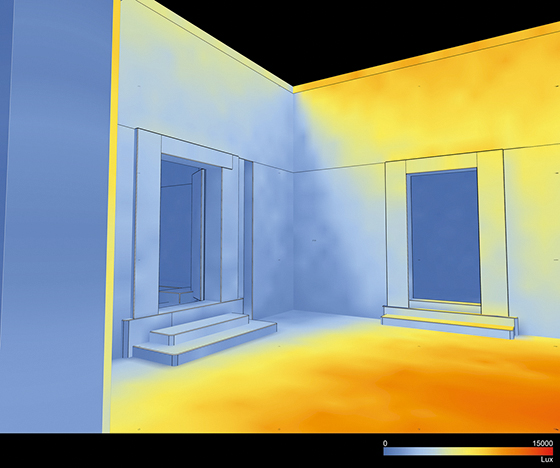
The Late Antiquity Modeling Project (LAMP) is an international, interdisciplinary research collective. LAMP uses computational and architectural methods to reconstruct the embodied experiences of ancient buildings and landscapes. In so doing, the project crafts more accurate and embodied histories of religious communities across geographic and temporal contexts. Of particular interest to LAMP is how these embodied reconstructions might be leveraged to rewrite the history of the first centuries of Christianity. Our current research centers on the late antique necropolis of El Bagawat in Egypt’s Kharga Oasis. Our previous research investigated the Christian Building at Dura Europus.
Facts
| Project duration: | 2018–ongoing |
| KIT researchers: | Dr. Joshua Silver – saai | Archive for Architecture and Civil Engineering |
Project partners
Dr. Camille Leon Angelo – University of Alabama, Department of Religious Studies.
Following up with the first project phase “emancipatory housing” (2018–2020), the subsequent project on German-Israeli architect Myra Warhaftig emphasizes her second, architectural-historical focus, the documentary work on the exile of Jewish architects during the Nazi period.

Facts
| Funder: | Deutsche Forschungsgemeinschaft (DFG) |
| Programme: | Research grant for non-personnel costs |
| Grant amount: | €178.000 |
| Project duration: | 2013–2030 |
| KIT researchers: | Prof. Dr. Martin Papenbrock – Professorship of History of Art |
Project partners
SAAI – Archive for Architecture and Engineering KIT.
Informationssystem Graffiti in Deutschland
The "Information System Graffiti in Germany" (INGRID) is a cooperation project of the Linguistics of German at the University of Paderborn and the History of Art at the Karlsruhe Institute of Technology (KIT). The task and aim of the project is to collect and digitize graffiti photos, annotate them systematically in a database and make them accessible for scientific research. The provision of legally usable images and high-quality metadata is intended to build a basis for cross-disciplinary scientific research in the field of graffiti.

Facts
| Funder: | Deutsche Forschungsgemeinschaft (DFG) |
| Programme: | Wissenschaftliche Literaturversorgung und Informationssysteme (LIS) |
| Grant amount: | Approx. €2.000.000 |
| Role KIT: | Project partner |
| Project duration: | 2012–2030 |
| KIT researchers: | Prof. Dr. Martin Papenbrock – Professorship of History of Art |
Project partners
Dr. Doris Tophinke and Dr. Gudrun Oevel, University of Paderborn.
Yearbook of the Guernica-Gesellschaft e. V.

Facts
| Funder: | Stiftung Kritische Kunst- und Kulturwissenschaften |
| Overall budget: | Approx. €3.000 p. a. |
| Project duration: | 1999–ongoing |
| KIT researchers: | Prof. Dr. Martin Papenbrock – Professorship of History of Art |
Project partners
Andrew Hemingway, London, University College.
An Ecocritical Perspective
The project explores Rubens’s late landscapes from an ecocritical point of view. Most authors consider those paintings a private activity informed by Stoic ideas of nature. However, the interrelations between Dionysian motifs, Epicurean ideas, and Rubens’s taste as a collector of antiquities reveal a complex materialistic and environmental awareness that challenges established ideas about early modern notions of nature, especially regarding the supposed moral superiority of culture above nature. The project delves into unexplored aspects of Rubens’s work, mainly focusing on how the artist integrated aesthetics, mythology, ancient philosophy, and scientific observation into his landscapes.

Peter Paul Rubens – Dance of Mythological Figures and Villagers (1630–1635). Source: Museo del Prado Madrid.
Facts
| Funder: | The Clark Art Institute, Williamstown, MA (USA) |
| Programme: | Research and Academic Program at the Clark Art Institute |
| Grant amount: | Approx. €26.000 |
| Role KIT: | Project partner |
| Project duration: | February to June 2026 |
| KIT researchers: | PD Dr. Dr. Jesús Muñoz Morcillo – Professorship of History of Art |
Project partners
Williams College, Williamstown, MA (USA).
ERASMUS+ Blended Intensive Program – BIP
In the BIP, international experts introduced key topics related to understanding Dionysian sources and their impact in postclassical times. Art historians and Classicists discussed with the students the challenges researchers face in fully understanding ancient sources, and the potential of classical tradition and ecocritical approaches as methodological tools to elucidate the role of the Dionysian mysteries in early modern intellectual circles, as well as in modern and popular culture. Within the frame of the BIP, the participants visited the Karlsruhe Collection of Antiquities at the Badisches Landesmuseum and the Collection of Early Modern Art at the Staatliche Kunsthalle Karlsruhe.

Moritz von Schwind – Tanz von Satyrn und Bacchantinnen um die Herme des Dionysos (1842). Source: Staatliche Kunsthalle Karlsruhe.
Facts
| Funder: | European Commission via DAAD |
| Programme: | ERASMUS+ and EPICUR |
| Grant amount: | €5.200 EUR and student stipends from their home institutions |
| Role KIT: | Project manager |
| Project duration: | June 30 to July 4, 2025 |
| KIT researchers: | PD Dr. Dr. Jesús Muñoz Morcillo – Professorship of History of Art |
Project partners
KIT International Affairs Business Unit, EPICUR Network, Universidad de Salamanca, Université de Strasbourg, Universidad Complutense de Madrid, Charles University Prague.
This project reframes ‘access-making’ as a critical and relational practice to explore how disability and race are configured in Donald Rodney’s Autoicon (1997–2000). More than a digital memorial, Autoicon is approached as a speculative interface that reimagines authorship, posthumous presence, and the ways in which access is shaped by both aesthetics and politics. Constructed from Rodney’s medical records, writings, and images, Autoicon offers a dispersed digital portrait that resists coherent identity. The project positions it as an early prototype of AI subjectivity, anticipating current debates on algorithmic representation and the ethics of digital memory. By examining the intersections of art, disability, and technology, this project rethinks code not as control but as a catalyst for access and aesthetic possibility. Referencing Jeremy Bentham’s Auto-Icon, Donald Rodney replaces the body with a dynamic archive, revealing how disabled artists have long anticipated and reshaped emerging technologies.
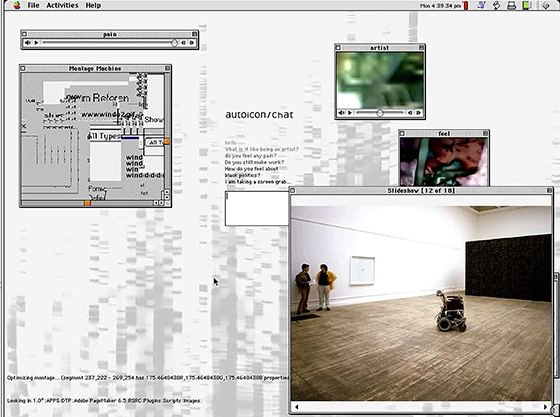
Chat function of Donald Rodney: Autoicon, 2000, CD-ROM version. ©The estate of Donald Rodney.
Facts
| Role KIT: | Project partner |
| Project duration: | 2024 |
| KIT researchers: | Dr. Virginia Marano – Professorship of Theory of Architecture |
Project partners
Lise Meitner Group “Coded Objects” led by Anna-Maria Meister at the Kunsthistorisches Institut in Florenz – Max-Planck-Institut.
Origins, Objects and Standardisation of Emergency Architecture in the UNHCR Handbook for Emergencies (1982)
In December 1982, the UNHCR published a small blue book of 200 pages with 14 sketches — and created one of the most influential documents in humanitarian emergency relief to date. This dissertation examines the first edition of the UNHCR Handbook for Emergencies as a turning point: from context-specific, often ad-hoc organised emergency architecture towards an increasingly institutionalised, globally operating apparatus. At its centre stands the Paradox of Standardisation — for the handbook paradoxically established the very professional standardisation it simultaneously sought to avoid, while explicitly calling for local, context-specific solutions and to "involve the refugees, whose home it will be."

Printed copies of the UNHCR Handbook for Emergencies, UNHCR Archives, Geneva (August 2022). ©Hannah Knoop
Facts
| Programme: | CuKnow |
| Overall budget: | €1.500 |
| Project duration: | 2020–2026 |
| KIT researchers: | Hannah Knoop – Professorship of Theory of Architecture |
Practices of Production and Exhibition in the Works of Eva & Franco Mattes and Evan Roth
From the perspective of an art history attentive to infrastructures and the networked condition of contemporary art production, this PhD project asks how to account for the omnipresence yet persistent invisibility of cables, and how to describe their function and materiality in artworks and exhibition spaces. Are cables a mere means to an end, an interchangeable utility, or an integral component of the work itself? Drawing on case studies by Evan Roth and Eva & Franco Mattes, whose works incorporate cables and visibly wire exhibition spaces, it asks whether art-historical methods are equipped to grasp their role, and tests approaches from infrastructure studies and STS.

Facts
| KIT researchers: | Erec Gellautz – Professorship of History of Art |
Tracing the Ecology of Architectural Production
This project examines the digital technologies which sustain the network of architectural design and construction. Through the specific hybrid practices which emerge with digital technologies, this research project seeks to account for the participants digital technologies draw into the design and construction process. Such an expansion in scope also draws the global extents of architectural digitality, including the ecological impacts of these technologies, into our current conceptions of practice. In this process, develop archival tactics and strategies for accessing, managing and preserving born-digital data in association with the KIT’s SAAI | Archive for Architecture and Engineering.

Facts
| Funder: | KIT Karlsruhe Institute of Technology |
| Programme: | Postdoc at saai |
| Project duration: | 2 years |
| KIT researchers: | Dr. Joshua Silver – saai | Archive for Architecture and Civil Engineering |
Architectural Image and Tectonics through the Photography of Germán Téllez in Bogotá, Colombia
The research focuses on photographer and architect Germán Téllez’ high‑contrast black‑and‑white architectural photographs from 1961 to 1985, treating them as a site where technical photographic processes and tectonic decisions are jointly negotiated. Moving between urban, architectural, and façade scales, close readings of selected images that reveal how deep structural expressions, material textures, and sun control devices produce and stage shadow in Bogotá’s modern buildings. By utilizing shadow both as a method and a research subject, the study argues for a shift from the European modern discourse focused on light and explores how the modern perspective is enacted in different latitudes.

Catedral Primada de Colombia, Germán Téllez Castañeda 1984, Registration Number 32186. ©Colección Museo de Bogotá
Facts
| KIT researchers: | Carolina Alvarez – Professorship of Theory of Architecture |