
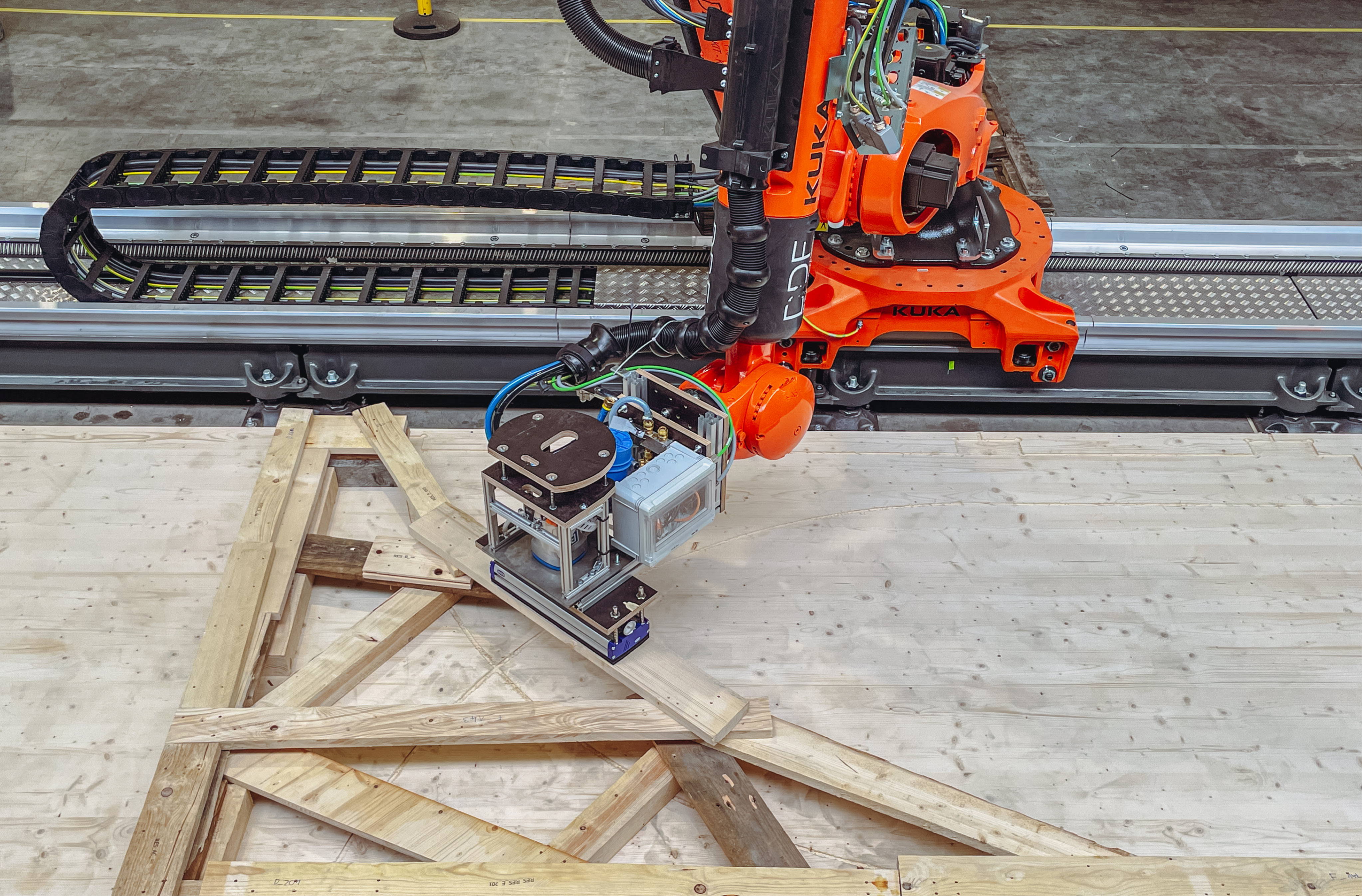
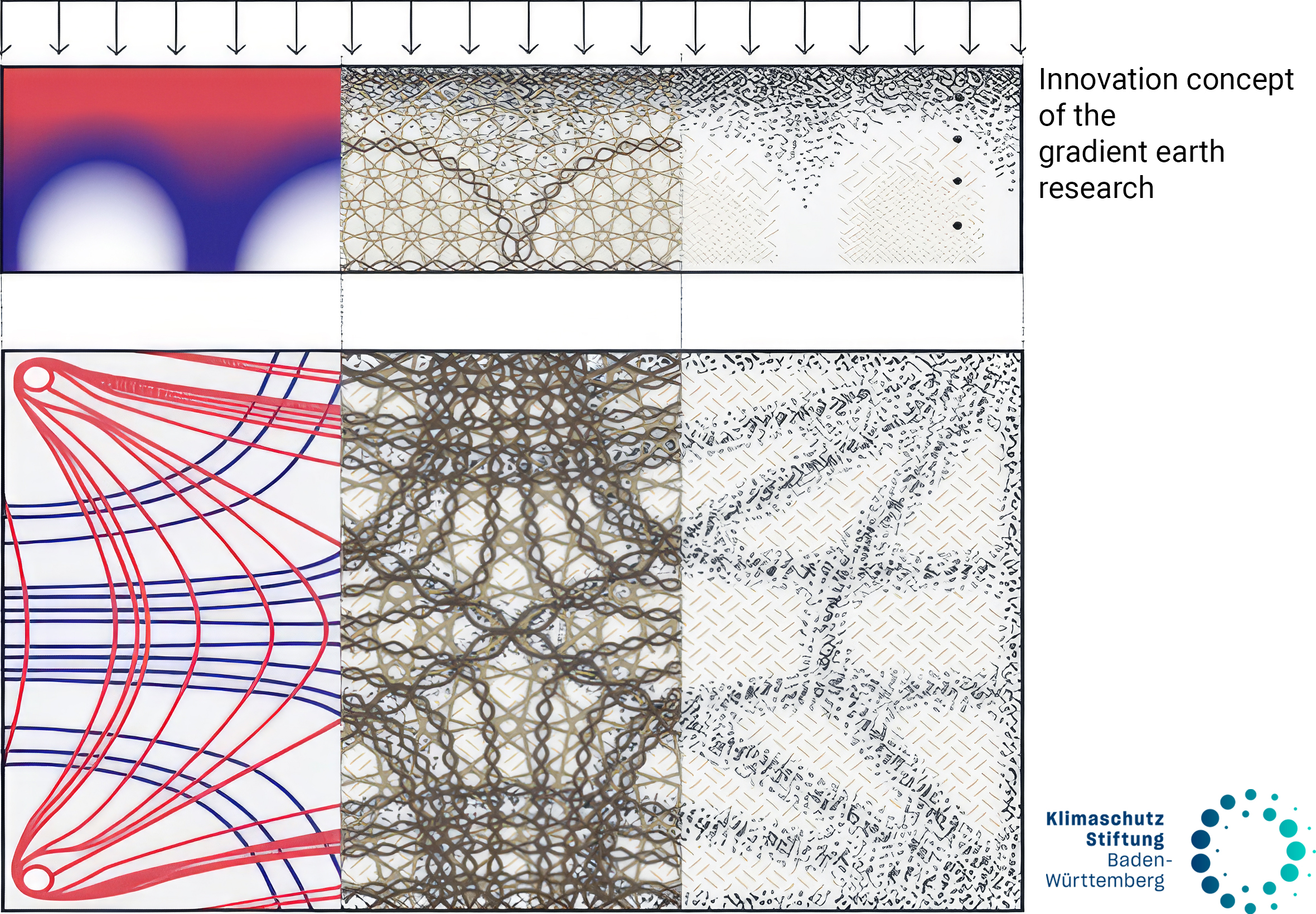
Research into the Robotic Prefabrication of a Locally Differentiated Clay-Fiber Composite Material System
The project combines the established research approach of gradient concrete with traditional earthen construction methods and their functional variations involving aggregate and straw additives, as well as current approaches to horizontally spanning earthen components with integrated biogenic tensile reinforcement.
Facts
| Funder: | Climate Protection Foundation Baden-Württemberg |
| Program: | Ideas Competition – Sustainable Construction Research |
| Total budget: | €98,900 |
| Grant amount: | €98,900 |
| Project duration: | 2026 |
| KIT researchers: | Prof. Moritz Dörstelmann – Chair of Digital Design and Fabrication |
In-Context Learning for Conversational Robotic Co-Fabrication in Construction
The project explores whether Vision Language Models (VLMs) can enable conversational control of industrial construction robots through in-context learning, without costly model training. Building on parameterized robotic skills (picking, placing, cutting, drilling), users describe fabrication goals in natural language while the VLM interprets context, plans sequences, and collaborates adaptively. This approach aims to replace expert programming with intuitive human–robot dialogue, lowering skill barriers and enabling agile, sustainable fabrication workflows. Full-scale experiments will test the limits of contextual reasoning for safe, goal-oriented robotic action in construction.

Facts
| Funder: | KIT Karlsruhe Institute of Technology |
| Program: | WildIdeas |
| Grant amount: | €79,850 |
| Project duration: | 2026 |
| KIT researchers: |
Prof. Moritz Dörstelmann – Chair of Digital Design and Fabrication ; T-T-Prof. Rudolf Lioutikov – Intuitive Robots Lab |
Komorebi is a research project by the KIT professorships in Design of Structures (dos) and Digital Design and Fabrication (DDF), focused on the development of a mobile shading structure to improve thermal comfort in urban public spaces. Addressing the lack of shade in many central urban areas, Komorebi combines seating with a lightweight, movable canopy made from bio-based materials, specifically wood and flax fibers. The project explores digital design, fabrication, architectural geometry, and elastically bent structures to create an adaptable and resource-efficient solution. Built as a full-scale demonstrator, it investigates microclimatic performance and aims to evolve into a scalable product for broader urban applications.

View of Komorebi on Karlsruhe’s Kronenplatz. @Tobias Wootton
Facts
| Funder: | KIT – IRM & Division IV |
| Role of KIT | Project partner |
| Project duration: | 2025–ongoing |
| KIT researchers: |
Prof. Dr. Riccardo La Magna – Chair of Structural |
Project partners
FORMIC Transportsysteme GmbH, FibR GmbH.
The Intelligence of Loss in the Architectural Archive
Archives are central sites of destruction, decay, and loss. Whether due to human causes or so-called natural disasters, much of humanity’s stored material has been—and continues to be—eradicated. But what if we treated loss not as a flaw, but as a feature? While AI is hailed as a solution to loss, its own processes of erasure follow distinct patterns, revealing new approaches to managing archival sustainability. This project explores the intersection of archival disappearance and AI-driven erasure, reframing loss as a promise of alternative ways of knowing.

Anobium tunnels in a book. Documentation “What’s eating your collection?” ©Birmingham Museum/Art Gallery
Facts
| KIT’s role: | Project partner |
| Project duration: | 2025–ongoing |
| KIT researchers: | Prof. Dr. Anna-Maria Meister – saai | Archive for Architecture and Civil Engineering |
Project partners
Rafael Uriarte – Institute of Art History in Florence (Max Planck Institute).
Fostering Entrepreneurial Teaching and Learning for Excellence in Vocational Education and Training (VET) in Tourism
The project aims to revitalize and modernize vocational education and training (VET) in the tourism sector through the use of Extended Reality (XR) technology. Whether delivered as Augmented Reality (AR), Virtual Reality (VR), or Mixed Reality (MR), Extended Reality has proven to be an impressive tool—especially since the pandemic—allowing digital content to be integrated into the real world simply by using personal devices, and paving the way for a higher quality of learning. Therefore, as this technology becomes increasingly user-friendly and cost-effective year after year, promoting a range of skills and competencies that enable teachers and students to use it in daily life is becoming increasingly important. TourXpeRience’s core objective is to equip vocational education and training (VET) students with the necessary skills and knowledge to become future leaders in the green tourism industry. Such an ambitious goal necessarily involves enhancing VET students’ skills, boosting teachers’ digital competencies, and fostering sustainable tourism entrepreneurship.

Facts
| Funder: | European Union |
| Program: | ERASMUS-EDU-2024-PEX-COVE |
| Total budget: | €3,842,136 |
| Grant amount: | €186,600 |
| KIT's role: | Project partner |
| Project duration: | 2025–2029 |
| KIT researchers: | Dr. Volker Koch, Tahereh Mallahnia, Yannick Scheerle – Chair of Building Lifecycle Management |
Project partners
International Center for the Promotion of Education (Italy), ITET Marco Polo (Italy), Learnable Società Cooperativa a R.L. (Italy), Istituto Tecnico Superiore per le Tecnologie Innovative (Italy), Asociación Empresarial de Investigación Centro T (Spain), Polytechnic University of Cartagena (Spain), Regional Employment and Training Service of the Region (Spain), Datey Eyrich GmbH (Germany), Regional Development Agency for Podravje – Maribor (Slovenia), Visja Strokovna Sola za Gostinstvo in Turizem Ma (Slovenia), Lukasiewicz Research Network – Institute of Technology (Poland), Shine 2Europe Lda (Portugal), Radom Chamber of Industry and Commerce (Poland), Institute of Biomechanics and Business Education (Greece), Institute of the Union of Greek Tourism Enterprises (Greece), Wittenborg University of Applied Sciences B.V. (Netherlands), Turismo de Portugal I.P. (Portugal), Szkola Glowna Gospodarstwa Wiejskiego (Poland), E.A.C.E. European Academy of Certified Education gGmbH (Germany), Interspread GmbH (Austria).
Bio-Inspired STEM Topics for Engaging Young Generations Through the Use of Augmented Reality
The main objectives of the Bios4You AR 2.0 project are to raise awareness among young students about STEM topics related to the biosciences, bioengineering, bioarchitecture, biotechnology, biophotonics, etc., and to create innovative educational materials using new AR technologies in a way that makes the learning experience much more engaging for both students and teachers.

Facts
| Funder: | European Union |
| Program: | Strategic Partnerships |
| Total budget: | €400,000 |
| Grant amount: | €74,200 |
| KIT's role: | Project coordinator |
| Project duration: | 2024–2026 |
| KIT researchers: | Dr. Volker Koch, Tahereh Mallahnia – Chair of Building Lifecycle Management |
Project partners
Kaunas University of Technology (Lithuania), EDUACT – DRASI GIA TIN EKPAIDEUSI (Greece), CEIPES (Italy), Tallinn Central Russian Gymnasium (Estonia), University of Palermo (Italy).
Revolutionary Architecture Design Through Generative AI Technologies
The project aims to develop and implement a new comprehensive, innovative, and efficient BIM tool. The integration of generative artificial intelligence, machine learning, and cloud computing will create intuitive user interfaces and advanced data analysis functions. This will simplify and optimize integrated and collaborative planning approaches. The ecological aspects the project focuses on include the integration of LCA to guide the planning process and support efficient energy planning. BLM is supporting the design and integration of modules on the innovative topics of sustainable construction, AI integration, and collaborative data management.

Facts
| Funder: | VDI/VDE Institute for Innovation and Technology |
| Program: | InvestBW – Innovation III |
| Total budget: | Total: €1,685,018 | KIT: €208,541 |
| Grant amount: | Total: €858,476 | KIT: €208,541 |
| KIT’s role: | Project partner |
| Project duration: | 2024–2026 |
| KIT researchers: | Prof. Dr. Petra von Both, Yannick Scherle – Chair of Building Lifecycle Management |
Project partners
neoBIM GmbH.
Wood Education for Sustainable Construction – Empowering professionals and students to build a more sustainable future through innovative and tailored training in circular wood and timber construction.
The WENUS project aims to revolutionize vocational education in wood and timber construction by integrating circular economy principles and 3D printing technology into the curriculum. This project focuses on developing sustainable practices and enhancing digital skills in the sector. Over a 24-month period, WENUS will develop a joint curriculum, practical training exercises (3D printing), and an e-learning platform, with the goal of equipping students and professionals with the skills needed for a sustainable future in construction.

Facts
| Funder: | European Union |
| Program: | Strategic Partnerships |
| Total budget: | €250,000 |
| Grant amount: | €79,500 |
| KIT’s role: | Project coordinator |
| Project duration: | 2024–2026 |
| KIT researchers: | Dr. Volker Koch, Maria Victoria Gomez Gomez – Chair of Building Lifecycle Management |
Project partners
CETEM (Spain), INNORENEW (Slovenia), Globalnet (Poland).
Methods for Reading Objects
Environments consist of designed objects: stacks of paper on desks, coffee cups next to them, the chairs one sits on—they all shape the way one interacts with and perceives the world. Objects are material things produced with specific intentions. They serve as epistemic evidence and entry points for understanding shaped environments, both historically and in the present. “Coded” is not an abstract technology, but the assumption that all objects have been shaped by cultural, social, technological, and aesthetic processes and bear traces of this shaping within themselves. “Coded Objects” develops methods for interpreting their form in order to critically understand the past, present, and potentially future environments they help to shape.

Stackable Dishware by Nick Roericht (1959). ©HfG Archive, Museum Ulm
Facts
| Funder: | Max Planck Society, Prof. Dr. Anna-Maria Meister – Chair of Architectural Theory, saai | Archive for Architecture and Engineering |
| Program: | Lise Meitner Excellence Program of the Max Planck Society |
| Total budget: | Approx. €2,000,000 |
| KIT’s role: | Project partner |
| Project duration: | 2023–2028 |
| KIT researchers: | Prof. Dr. Anna-Maria Meister – Chair of Theory of Architecture |
Project partners
Anna-Maria Meister – Institute of Art History in Florence (Max Planck Institute).
German Bureaucratic Paper Architectures from ca. 1922, 1936, 1953
The German term “Norm” straddles the line between technical regulation and social conduct. This project investigates how institutions and their agents sought to reshape the world one piece at a time: by determining the dimensions of a window, they framed the inhabitant’s view of the world; by standardizing paper formats, they defined the physical interaction between citizen and state. Through the design of standardized objects in three different German states—the Weimar Republic, the National Socialist regime, and postwar reconstruction in West Germany—they produced and disseminated aesthetic and societal values. This project treats norms, standards, and their objects as the core of aesthetic and political intentions.

The Norm Format and its Entourage – Drawing by Walter Porstmann, before 1927. ©Bernd Freese Collection
Facts
| Project duration: | Ongoing |
| KIT researchers: | Prof. Dr. Anna-Maria Meister – Chair of Theory of Architecture |
Project partners
Anna-Maria Meister – Institute of Art History in Florence (Max Planck Institute).
Archival Constructs Between Index Cards and AI
If you were to browse through the complete catalog of the saai, you would find works by over 200 firms and architects—yet only a few of them are women, or involve practices and spaces created for or by marginalized groups or diverse actors. If metadata are understood as objects—as are their processes, infrastructures, and consequences—then techniques for their virtual indexing can be derived from the human-generated information contained in collected objects. Only by critically examining the archive’s material techniques and value systems can blind spots be revealed—and addressed in AI applications.

The index card accompanying the Egon Eiermann estate describing the competition materials for the Kaiser-Wilhelm-Gedächtniskirche in Berlin. ©Mechthild Ebert, saai
Facts
| Role of KIT: | Project partner |
| Project duration: | Ongoing |
| KIT researchers: | Prof. Dr. Anna-Maria Meister, Joshua Silver, Mechthild Ebert – saai | Archive for Architecture and Civil Engineering |
Project partners
Institute of Art History in Florence (Max Planck Institute), Sina Brückner-Amin (German Museum).